Skip to main content Skip to main navigation menu Skip to site footer
logo
  • DRJAFS Home
  • About DRJAFS
  • Instructions
  • Aims & Scope
  • DRJAFS Editors
  • Submit Manuscript
  • About
    • Editorial Policies
    • Anti-Plagiarism Policy
    • Peer Review Process
    • Publication Ethics
    • Indexing
    • Announcements
    • Privacy Statement
    • Contact
  • Current
  • Archives
Search
  • Register
  • Login
  1. Home /
  2. Archives /
  3. Vol. 14 No. 1 (2026): Direct Research Journal of Agriculture and Food Science
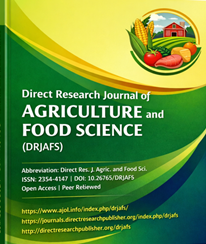
Vol. 14 No. 1 (2026): Direct Research Journal of Agriculture and Food Science

					View Vol. 14 No. 1 (2026): Direct Research Journal of Agriculture and Food Science
Published: 2026-01-09

Articles

  • Toxicological, Haemato-Biochemical, Oxidative and Histopathological Evaluation of Methanolic and Aqueous Extract of Carica papaya Seed and Leaf in Wister Rats

    Toxicological, Haemato-Biochemical, Oxidative and Histopathological Evaluation of Methanolic and Aqueous Extract of Carica papaya Seed and Leaf in Wister Rats

    Karaye Gloria Pisha, Paul Davou Kaze, Asabe Cecilia Kogi, Ajanusi Joseph, Abraham Goni Dogo (Author)
    1-11
    • PDF
  • Assessment of Humid Tropic Soils for Freshwater Fish Farming Using Earthen Pond in Beeri, Khana Local Government Area, Rivers State

    Assessment of Humid Tropic Soils for Freshwater Fish Farming Using Earthen Pond in Beeri, Khana Local Government Area, Rivers State

    K.D. Peter, T. E. Alexander (Author)
    12-19
    • PDF
  • Effects of Organic and Inorganic Fertilizers on Some Physical and Chemical Properties of Ultisols and Growth Parameters of Okro (Abelmoschus esculentus)

    Effects of Organic and Inorganic Fertilizers on Some Physical and Chemical Properties of Ultisols and Growth Parameters of Okro (Abelmoschus esculentus)

    K. D. Peter, A. E. Edisa (Author)
    20-25
    • PDF
  • Influence of Roasting time and ingredient optimization on the Nutritional, Sensory and Storage Quality of Sesame-Honey spread

    Influence of Roasting time and ingredient optimization on the Nutritional, Sensory and Storage Quality of Sesame-Honey spread

    Christina Abi Atingah, John Adanse, Matilda Lenia (Author)
    26-39
    • PDF
  • The Inadequate soil fertility remains a major constraint to maize production in Ghana and large areas of sub-Saharan Africa, especially in regions having weathered Ultisols with low organic matter and nutrient-holding capacity. The present study investigated the impact of locally produced agricultural residue-derived biochar on maize yield under field conditions in Ghana. Biochar was obtained from cocoa pod husk, rice straw and corn cob by pyrolysis at 500°C for 45 minutes in the total absence of oxygen and chemically characterised. The field study was carried out at Kwadaso, Ghana, in a split-split plot design with three replications over the principal and minor crop seasons. Treatment included biochar type and application rate (2.5 t ha⁻¹, 5 t ha⁻¹) in comparison with fertilizer. The pH of all the biochars was strongly alkaline (pH 10.3–10.4). Soil amendment Biochars made of rice straw showed the highest organic C (41.0%) and available P (343.6 mg kg⁻¹), whereas those derived from cocoa husk had the highest exchangeable base cations. Application of biochar significantly enhanced the growth and yield of maize as compared to the control. At 5 t ha⁻¹, application led to a 32.9% and 58% increase in grain and cob yields, respectively. Response in yield was not dramatically different among the biochar types. These findings confirm that indigenous biochar feedstocks increase the productivity of maize and the sustainable management of soil fertility in Ghana.

    Nutrient Characteristics of Biochar Derived from Cocoa Husk, Rice Straw and Corn Cob and Their Effects on Maize Yield in Ghana

    Bernice Amoafoa, Collins Agyei Menka, Iddrisu Sumaila (Author)
    40-49
    • PDF
  • Climate change has emerged as a major concern for governments, scholars, and development stakeholders due to its far-reaching implications for human security and social stability, particularly in developing regions. In East Africa, climate variability and extreme events increasingly intersect with existing socio-economic and political vulnerabilities, intensifying inter-community conflicts, especially among pastoralist communities. However, existing empirical studies provide fragmented and sometimes contradictory evidence regarding the relationship between climate change and conflict. This article adopts a systemic literature review approach to examine the nexus between climate change and inter-community conflict in East Africa, with a specific focus on pastoralist groups. Following PRISMA guidelines, peer-reviewed articles were systematically retrieved from Scopus, Web of Science, and Google Scholar, JSTOR, etc. covering the period 1995-2025. Studies were selected based on predefined inclusion and exclusion criteria focusing on climate change impacts, pastoralist livelihoods, conflict dynamics, and human security outcomes. The findings reveal that the relationship between climate change and inter-community conflict is highly context-dependent rather than deterministic. Climate-induced resource scarcity, livelihood disruption, migration, and pastoral mobility interact with social political processes, governance structures, and institutional weakness to shape conflict outcomes. In many cases, declining access to land and water undermine pastoralist livelihoods, exacerbate competition, and heightens human insecurity, thereby increasing the likelihood of conflict. The review contributes to the literature by systematically synthesizing dispersed empirical evidence and advancing a nexus-based analytical understanding of climate change and inter-community conflict among pastoralist communities in East Africa. It further highlights the critical role of governments and stakeholders in strengthening adaptive capacity, enhancing resilience, and promoting diversified livelihood strategies as pathways to conflict prevention and sustainable human security.

    Climate Change and Inter-Community Conflict in East Africa: A Systematic Review of Pastoralist Livelihoods and Human Security

    Lydie Muneza (Author)
    50-60
    • PDF

Latest publications

  • Atom logo
  • RSS2 logo
  • RSS1 logo

Information

  • For Readers
  • For Authors
  • For Librarians

Make a Submission

Make a Submission

logo

The mission of Direct Research Journals Publisher is to provide a website that will hold scholarly articles in the archives of the journals. Academicians and researchers can get access to the full articles via the archives of the journals without any financial barrier. Hence Direct Research Journals Publisher fully supports the open-access model of publishing scholarly articles.
Submit Manuscript

About Us

Contact Us


Creative Commons


Open Access
More information about the publishing system, Platform and Workflow by OJS/PKP.

© 2025 Direct Research Journals.
More information about the publishing system, Platform and Workflow by OJS/PKP.